SBEM vs DSM
While many landlords default to SBEM for simple buildings and DSM for complex ones, is this rules-based approach truly the most strategic option?
SBEM vs. DSM: Choosing the Right Path to EPC Compliance
In the world of non-domestic Energy Performance Certificates (EPCs), your choice of simulation methodology can be the difference between a 'Pass' and a 'Fail' under Minimum Energy Efficiency Standards (MEES), directly influencing capital expenditure. While many landlords default to SBEM for simple buildings and DSM for complex ones, is this rules-based approach truly the most strategic option?
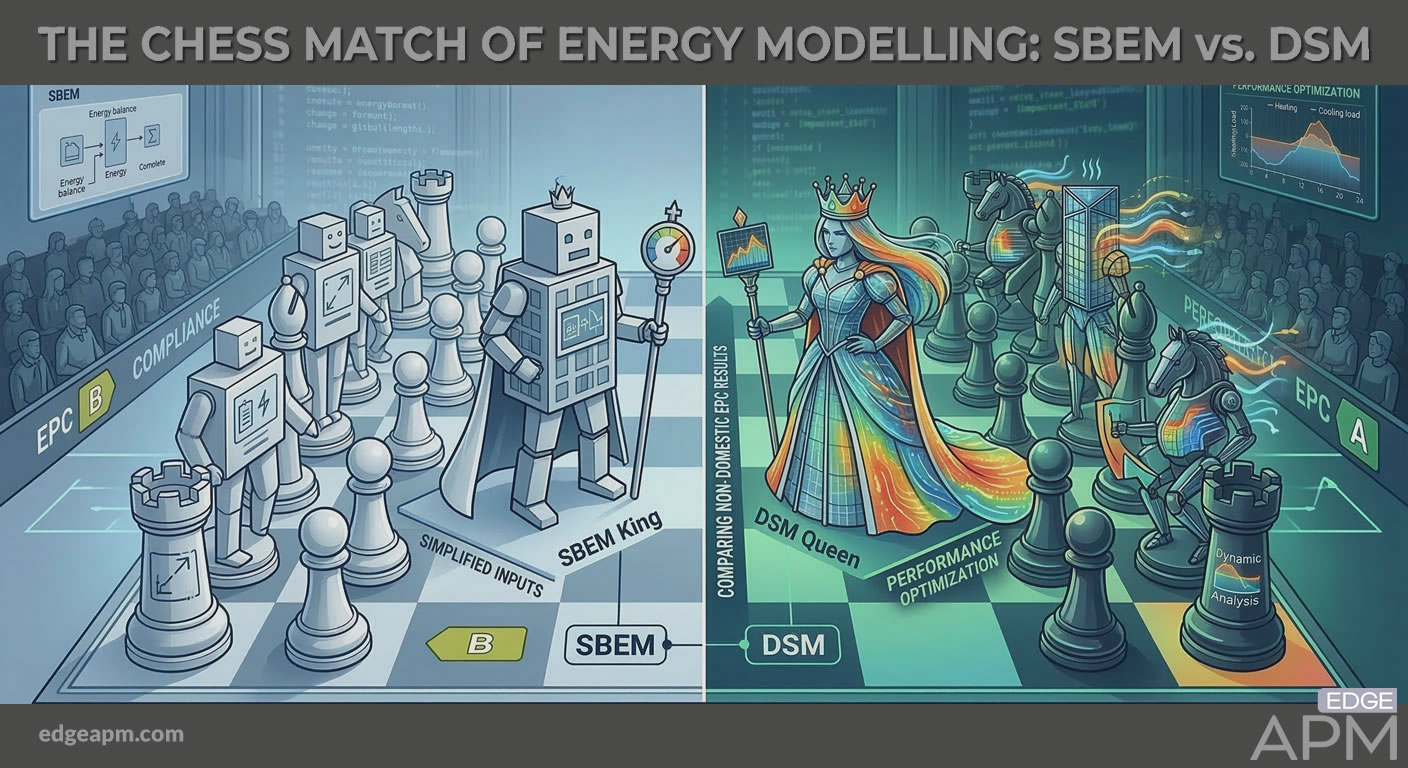
The Dilemma
It is generally understood that Dynamic Simulation Modelling (DSM) is the more robust of the two options. The results are more accurate, the model itself is far more useful for asset management and engineering purposes, and the barrier to entry for Level 5 (DSM) assessors is significantly higher. However, DSM often attracts a fee premium over the Simplified Building Energy Model (SBEM), and the results can differ wildly.
A common misconception among assessors is that the UK Government mandated a percentage "cap" on the divergence between DSM and SBEM results. This is only partially true; tolerances apply only during the software validation stage, where a tool must match the government's reference engine (iSBEM) within set parameters for standardised test cases.
This does not, however, apply to general use. If a building has, for example, complex shading from a nearby skyscraper or a high-thermal-mass concrete construction, SBEM (which relies on monthly averages and cannot compute shading from other buildings or objects) will be inaccurate compared to DSM (which uses hourly or sub-hourly calculations and can account for external shade). Because of this, the government cannot cap the difference in the field. If DSM yields an 'A' and SBEM yields a 'C', provided the inputs are correct, the 'A' is the legally accurate reflection of reality.
MEES: A Blunt Instrument
In England and Wales, MEES makes it difficult to let properties with an 'F' or 'G' rating. Successive governments have stated intentions to strengthen this requirement to a 'B' rating by circa 2030. Consequently, many fund and asset managers have adopted a de facto minimum target of 'B' for their portfolios.
EPCs are, therefore, no longer a "tick-box" compliance exercise. Poor results directly impact transactional values and capital costs. Since both methodologies are perfectly acceptable for commissioning an EPC, how do you know which to select?
The "Winner Stays" Strategy
At EDGEAPM, we initially looked for patterns: we observed that warehouse-type buildings with roof lights often performed better under DSM, while basic retail units in shopping centres often fared better in SBEM. However, these patterns were not universal. We realised we could not guarantee which methodology would produce the more favourable result based on building type alone.
Mindful of these inconsistencies, we developed the DSM + SBEM option. On behalf of our clients, we commission a Level 5 DSM EPC and require the assessor—working to our strict ‘APM house modelling standard’—to simultaneously generate an additional SBEM model for a marginal fee. We then "pick the winner," guaranteeing the best possible outcome in 100% of cases.
Results in Numbers
As a data-driven company, we recently analysed 647 buildings across multiple asset classes where we held both SBEM and DSM models. The findings challenged the common narrative that "DSM is always better."
While these results are compelling, they do not yet provide a complete picture as they don't account for variations across specific asset classes. For example: Does DSM outperform SBEM in warehouse/industrial assets, and if so, by what margin? As our data pool grows, these are the questions we intend to answer.
The Comparison Breakdown:
In 54% of cases, the choice of methodology did not change the final EPC letter grade.
Where the methodology did improve the grade:
26% shifted in favour of SBEM.
20% shifted in favour of DSM.
A Game of Strategic Chess
Do we intend to change our advice to clients based on this study? The short answer is no. We continue to recommend the dual DSM + SBEM approach for several reasons:
Optimisation: Ensures the best possible EPC result is lodged.
Cost Savings: The additional cost of this approach is insignificant compared to the capital costs of an improvement strategy that might not be required—or that can be deferred to align with the building's natural plant life cycle.
Versatility: Clients can rely on the DSM for engineering support, such as more accurate plant sizing.
Continuity: A DSM can be converted into a "real-world" building model for deep-dive energy analysis.
Interoperability: Having access to both models allows our platform to bridge the data gap often found in proprietary formats. We transform data that was previously locked away into an accessible, useful asset for fund and asset managers.
About EDGEAPM
EDGEAPM’s APM software supports the asset management of 4,058 buildings covering 6,170,342m² across the UK. Our platform helps funds create accessible, non-proprietary digital data twins from EPC models. While traditional software-generated models (such as IES) often require a specialist to access the data, EDGEAPM is software-agnostic—allowing surveyors and managers to leverage EPC data for high-level asset and fund management purposes.
To ensure our clients have access to the most accurate models, EDGEAPM operates a dedicated EPC bureau and helpdesk, ensuring all modelling is undertaken to a rigorous house standard.
EDGEAPM is a proud contributor to the