London Plan's carbon reporting
It is impossible to comply with the London Plan's carbon reporting spreadsheet while also complying with Part L
There is a big problem with carbon offsetting for new-build data centres in London.
I believe many millions of pounds per development may have been
paid out incorrectly under the London Plan and its requirement for a carbon
offset. This a big problem for a number of reasons.
Firstly, the market for data centres is growing. The data centre market in
London has seen significant growth as an investment class, driven by the digital
transformation across industries. London’s strategic location and robust digital
infrastructure make it a preferred choice for data centre investments.
According to CBRE, in 2022 the London data centre market represented about
80% of the UK total and was on track for a record year. JLL, in its EMEA Data Centre
Report Q3 2023, advised that although there was a slowdown in new supply in
2023, London had the largest colocation market in Europe.
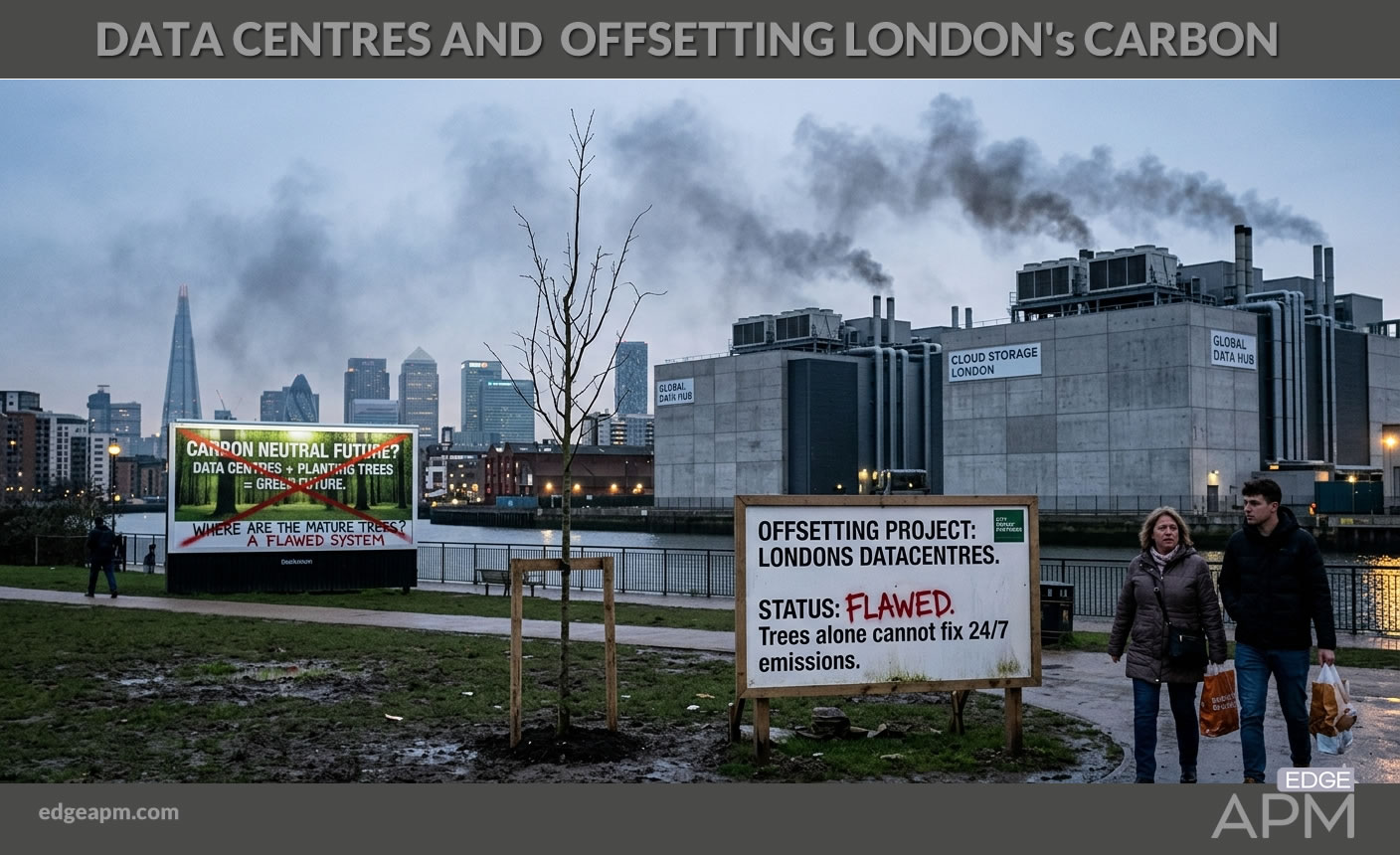
Carbon offset payments
All new major development in London is subject to the London Plan. From a
data centre perspective, this mandates an energy hierarchy as part of a trajectory to
a zero-carbon target. Where it is clearly demonstrated that the zero-carbon
target cannot be fully achieved on-site, any shortfall should be provided, either
through a cash-in-lieu contribution to the borough’s carbon offset fund, or off-site,
provided that an alternative proposal is identified and delivery is certain.
Many developers opt for the offset payment. The London Plan’s recommended offset is calculated as £95
per tonne for 30 years (£2,850 per tonne) but some boroughs set it much higher.
This offset is calculated using the GLA’s carbon emission reporting spreadsheet
but the calculation itself is based on the Building Regulations (2010) Approved
Document Part L Volume 2 (2021 edition incorporating 2023 amendments)
and its “regulated” emissions. While “unregulated” emissions should also be
calculated, they are reported in the “EUI & space heating demand” sheet, and this
does not inform the offset calculation.
About EDGEAPM
EDGEAPM’s APM software supports the asset management of 4,058 buildings covering 6,170,342m² across the UK. Our platform helps funds create accessible, non-proprietary digital data twins from EPC models. While traditional software-generated models (such as IES) often require a specialist to access the data, EDGEAPM is software-agnostic—allowing surveyors and managers to leverage EPC data for high-level asset and fund management purposes.
To ensure our clients have access to the most accurate models, EDGEAPM operates a dedicated EPC bureau and helpdesk, ensuring all modelling is undertaken to a rigorous house standard.